
The most encouraging, practical, and genuinely doable guide to cabinet organization for beginners — because every organized kitchen started exactly where yours is right now, and getting from here to there is so much more achievable than it looks.
I want to say something to you before this guide begins — something I mean completely and that I think you might actually need to hear right now.
If you are reading a guide called “Cabinet Organization for Beginners: Where to Start When Everything Is a Mess” — you are exactly where you need to be. Not behind. Not hopeless. Not someone who is constitutionally unable to be organized.
You are a person who has decided that the mess has gone on long enough and that today is the day you figure out where to start. That decision? That is the entire hard part. Everything else in this guide is just showing you the steps.
I know how a disorganized kitchen feels from the inside. I know the specific frustration of opening a cabinet and having something fall out. I know the feeling of knowing you own something but having no idea which cabinet it is in.
I know the way a chaotic kitchen makes cooking feel like an obstacle course rather than the pleasurable, creative thing it is supposed to be. And I know how looking at the whole situation — all the cabinets, all the clutter, all the stuff — can make the whole project feel so overwhelming that you close the cabinet door and tell yourself you’ll deal with it when you have more time, more energy, a better plan.
My friend Fatima felt all of this. She is the most self-described disorganized person I know — she says she genuinely believed that being organized was a personality trait she did not have, like being tall or being musical.
Her kitchen cabinets were, and she has given me permission to say this, chaotic in a way that made cooking in them genuinely difficult. She started a cabinet organization project three times and abandoned it all three times, each time getting overwhelmed and retreating.
The fourth time, she started differently. She started with one cabinet. Just one. She spent forty-five minutes on it. She finished it completely. She looked at it for a moment. And then — her words, which I am repeating verbatim — she said “Oh. I can do this.” She organized the entire kitchen over the next three weekends, one cabinet at a time. She has maintained it for fourteen months.
This is the guide I wish she had had at the beginning. It is written for exactly where you are right now.
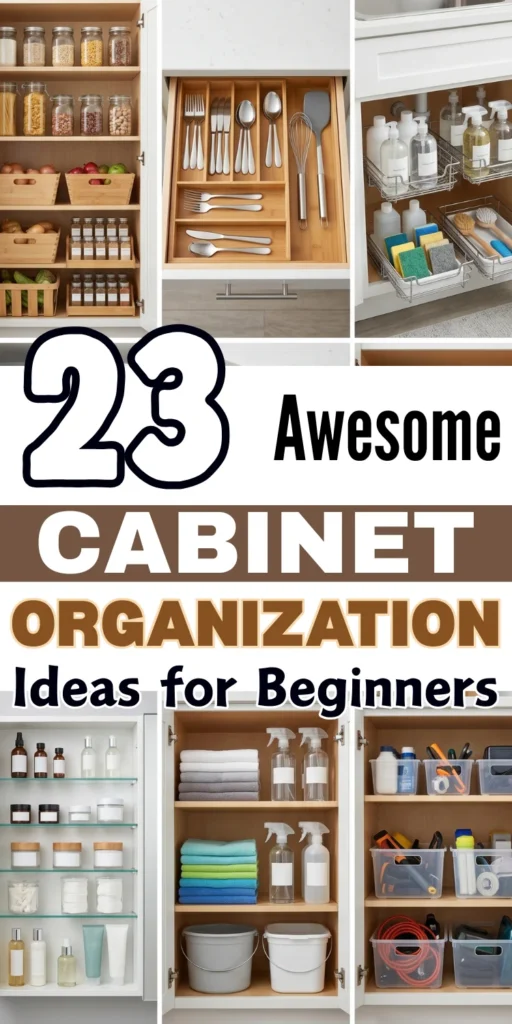
First: Understand What “Organized” Actually Means for Cabinets
Before you move a single thing, I want to recalibrate what organized means — because the version of organized that most beginners are comparing their cabinets to is the wrong version, and comparing yourself to it is part of what makes starting feel so impossible.
Organized does not mean Pinterest-perfect. It does not mean matching acrylic bins in three sizes. It does not mean everything labeled in a beautiful font. It does not mean your kitchen looks like a staged home photoshoot or a professional organizer’s portfolio.
Organized, in the practical, real-world, sustainable sense of the word, means this: every item in your cabinet has a designated home, and that home makes logical sense based on where and how you use the item. That is the entire definition. A cabinet where the coffee mugs are directly above the coffee maker and the pasta is near the stove and the Tupperware has a designated section rather than being scattered across three cabinets — that cabinet is organized, even if it does not look like anything you have ever seen on Instagram.
The practical test for whether a cabinet is organized: can you find any item in it in under fifteen seconds? Can you return any item to it without wondering where it goes? Do things stay where you put them because the home makes logical sense?
If yes — organized. If no — needs a system. That is the only standard that matters for cabinet organization for beginners.
Hold this definition in mind as you work through everything that follows.
The Three Things You Need Before You Touch Your First Cabinet
You do not need bins. You do not need a label maker. You do not need anything from Amazon. Here are the three things you actually need to start cabinet organization as a complete beginner.
Thing 1: A garbage bag and a donation box.
Before any organizing can happen, some decluttering needs to happen. Not a whole-house declutter — just a small one. As you go through each cabinet, you are going to find things that are broken, expired, that you never use, or that you have three of when you only need one. You need somewhere for those things to go that is not back into the cabinet. A garbage bag for things to throw away. A box for things to donate. Both should be within reach at all times during the project.
Thing 2: Clean rags and a basic cleaner.
When you empty a cabinet — even partially — wipe it out before you put anything back. Empty cabinets are far easier to clean than full ones, and starting fresh on a clean surface makes the whole organization feel more intentional and more satisfying. You do not need specialty cabinet cleaner — a damp cloth with a small amount of dish soap works perfectly.
Thing 3: Thirty to sixty uninterrupted minutes.
This is the resource that matters more than any product. Cabinet organization for beginners works best in contained time sessions — enough time to fully empty, sort, declutter, clean, and reorganize one specific cabinet without having to stop in the middle. Stopping mid-cabinet is how cabinets end up more chaotic than when you started. Set aside a specific time for each session and treat it like an appointment with yourself.
That is it. You already have everything you need. Now let’s talk about where to start.
Step 1: Choose the Right First Cabinet — This Decision Matters More Than You Think
The single most important strategic decision in cabinet organization for beginners is which cabinet to do first. And the right answer is not “the most chaotic one” or “the biggest one” or even “the most visible one.”
The right first cabinet is the one where success will feel most obvious, most immediate, and most motivating. Because the purpose of the first cabinet is not only to organize that cabinet — it is to give you proof that you can do this, that the process works, and that the result is worth the effort. The first cabinet is your evidence cabinet. It is the one that makes the next one feel possible.
With that in mind, choose your first cabinet using these criteria:
It should be relatively small or contained. A single shelf or a single small cabinet is better than a large pantry cabinet or a deep corner cabinet. You want to be able to finish completely in one session.
It should show visible, satisfying results quickly. The everyday dish cabinet, the mug cabinet, the utensil drawer, or the food storage container cabinet are all excellent first choices because their before and after is visually obvious and immediately satisfying.
It should be a cabinet you use every day. The improvement in your daily experience should be immediate and frequent, reinforcing the value of the work you just did every time you use it.
Avoid starting with: the junk drawer, the deep corner cabinet, the under-sink cabinet, the pantry, or any cabinet that has not been touched in years. These have their place in the sequence — but they are not the right starting point.
My recommendation for most beginners: start with the everyday dishes cabinet or the mug cabinet. It is typically a small space, the contents are straightforward (dishes and mugs do not require much decision-making), and the result — a neatly organized shelf of dishes you reach for every day — is immediately visible and immediately satisfying.
Step 2: The Four-Step Method for Every Single Cabinet
Once you have chosen your first cabinet, here is the exact four-step method you use for that cabinet and for every subsequent one. This method is the same for every cabinet regardless of size, regardless of contents, regardless of how chaotic it currently is.
Step A: Empty Completely
Pull every single item out of the cabinet. Every. Single. Item. Put everything on the counter or table in front of you. Do not leave anything in the cabinet — not even things you know you want to keep, not even things that obviously belong there. Everything out.
This step matters because you cannot assess a cabinet’s storage potential or plan its organization while things are still in it. Empty cabinets look different from full ones — you see the actual space, the actual depth, the actual height between shelves. And you cannot genuinely sort items when they are half-in and half-out of a cabinet.
Step B: Sort and Declutter
With everything on the counter, sort into groups: Keep, Donate, and Trash. As you sort, ask three honest questions about each item:
Do I use this at least once a month? Do I actually need this specific item or do I have three of them when I only need one? Is this in good enough condition to be worth keeping?
If the answer to any of these is clearly no — the item goes to Donate or Trash. Do not keep things out of guilt about money spent or gifts received. Do not keep things because you might use them someday if someday has not arrived in the past year. The goal is to keep only what you actually use and actually need in this specific cabinet.
For a dish cabinet, this might mean acknowledging that you have fourteen coffee mugs for a household of two — and that keeping the six you actually love and donating eight perfectly good mugs you never reach for is not wasteful. It is organized.
Step C: Clean the Empty Cabinet
With everything out, wipe the cabinet interior completely. Bottom shelf, side walls, back wall, and the ceiling of the cabinet. Use a damp cloth with dish soap. Dry with a clean cloth. If there are any shelf liner pieces that are peeling, ripped, or stained — this is the moment to replace them or remove them entirely.
A clean cabinet before you put anything back makes the finished result feel significantly more intentional and fresh. It takes three minutes and it matters.
Step D: Return Items With Intention
Now put your Keep items back — but not randomly. Place them according to the simple logic that makes cabinet organization work: most frequently used items at the front and at the most accessible height, least frequently used items at the back or higher up. If there are natural groupings within the category, keep them together.
For a dish cabinet: everyday plates at the front, everyday bowls beside them, everyday mugs on the next shelf. Serving bowls and special occasion pieces on the higher or deeper shelf. Everything you reach for every day is immediately visible and immediately accessible.
That is the entire method. Empty, sort, clean, return with intention. Four steps, one cabinet, thirty to sixty minutes. Done.
Step 3: The Correct Sequence for the Rest of Your Cabinets
After your first cabinet is complete, the sequence you follow for the rest of your cabinets matters — because starting with the right cabinets first builds momentum, and tackling the hardest ones before you have that momentum is how projects get abandoned.
Here is the sequence I recommend for cabinet organization for beginners:
Start with: Daily-use food storage and dishes (the first cabinet you did), then the mug and glass cabinet, then the everyday utensil drawer.
Second phase: The cabinet directly above or beside the cooktop (cooking tools and oils), the pot and pan cabinet below the cooktop, the spice storage.
Third phase: The pantry shelves or food storage cabinets — working from one shelf at a time rather than the whole pantry at once.
Fourth phase: The less-used and more complex cabinets — the cabinet with the awkward appliances, the under-sink cabinet, the corner cabinet.
Last: The junk drawer. This is last not because it is least important but because by the time you get here, you have established the process, built the habit, and have enough momentum to tackle the decision-heavy, no-clear-category nature of a junk drawer without it derailing the whole project.
This sequence puts the easiest and most frequently used cabinets first, builds confidence and habit through the middle phase, and saves the genuinely difficult decisions for when you have the most experience and momentum to handle them.
Step 4: The Only Organizing Principle You Actually Need to Know
There are many principles of cabinet organization — whole books and guides devoted to the subject. But for beginners, there is one principle that is more important than all the others combined, and if you apply only this one thing, your cabinets will be dramatically more organized than they are right now.
Everything that lives in a cabinet should live near where it is used.
Cooking oils near the cooktop. Dishes near the dishwasher or the table. Coffee supplies near where you make coffee. Baking supplies near where you bake. This principle — proximity to point of use — is the organizing logic that makes everything intuitive and everything easy to return.
When something lives near where it is used, you reach for it naturally, you find it naturally, and you return it naturally because returning it to its cabinet requires almost no extra movement from where you just used it. When something lives far from where it is used, every retrieval requires crossing the kitchen, and every return requires motivation that you often do not have when you are tired, hungry, or in a hurry.
Apply this principle to every cabinet you organize and your kitchen will begin to flow in a way it has never flowed before.
Step 5: The Question of Bins, Baskets, and Organizers — When to Buy Them and What to Get
At some point in the process, you will look at a cabinet you have just organized and think “this would work better if I had a small bin for these items” or “a lazy Susan would make this much more accessible.” That feeling is correct — and it is the right time to buy organizers. Not before. Now.
This is the exact sequence: organize first with what you have, identify the specific need that a product would solve, then buy the specific product for that specific need.
This is the opposite of how most people approach cabinet organization. Most people buy a bunch of organizers first and then try to fit their cabinets around the organizers. This produces cabinets full of organizers that are the wrong size, the wrong type, or solving a problem that does not actually exist in that space.
After you have organized a cabinet with the four-step method and lived with it for a week, the specific needs become obvious:
“The canned goods keep falling over — I need a can organizer or a small bin to corral them.” → Buy a small clear bin or a can organizer in exactly the right size for your specific shelf.
“The spices in the back are impossible to see — I need a lazy Susan.” → Buy a lazy Susan in the diameter that fits your specific shelf.
“The pots and pans are still hard to access — I need a pull-out shelf.” → Buy a pull-out shelf in the exact dimensions of your specific cabinet.
Every purchase is the solution to a specific, identified problem. Nothing is bought on speculation or because it looked good online. This approach produces cabinets where every organizer is exactly right for its space — which is what makes organization last.
Step 6: Maintain What You Have Built With a Five-Minute Weekly Habit
The part of cabinet organization that nobody wants to talk about but that determines whether everything you have done lasts or drifts back to chaos: maintenance.
Here is the truth about cabinet organization maintenance: it takes five minutes a week if you do it every week, and it takes a weekend if you let it go for three months. Those are your options.
The five-minute weekly cabinet maintenance habit is this: at the end of the week, open each cabinet you have organized and take thirty seconds to check its current state. Is everything in its home? Has anything migrated to the wrong spot? Is there anything that needs to go back to where it belongs?
When you do this weekly, any drift is caught and corrected while it is still a minor drift — one item in the wrong place rather than a whole cabinet that has reverted to chaos. The weekly habit is the difference between organization that lasts and organization that has to be redone.
My friend Fatima does her cabinet check every Sunday evening while her coffee is brewing — she says it takes about four minutes total for her whole kitchen and she has never had a cabinet that needed more than a small straightening since she started the habit.
What Happens When You Hit a Wall (Because You Will, and That Is Okay)
I want to be honest about something. At some point during your cabinet organization project, you are going to hit a wall. Maybe it is the under-sink cabinet that feels too complicated. Maybe it is the junk drawer that has too many miscellaneous items with no logical categories. Maybe it is a cabinet full of things from a previous season of life that trigger complicated feelings.
When you hit a wall, here is what you do: skip that cabinet for now. Move to the next one. Come back to the hard one when you have more energy, more momentum, and more perspective from having successfully organized everything else.
The wall is not evidence that you cannot do this. It is evidence that some cabinets are harder than others and that doing the easier ones first was the right strategy. The wall is not the end of the project. It is just a cabinet that needs to wait its turn for a moment when you are better equipped to handle it.
Every single person who has ever successfully organized their kitchen hit at least one wall. The difference between the people who finished and the people who did not is not that the finishers hit fewer walls. It is that the finishers went around the walls by moving to the next cabinet rather than giving up at the one that stopped them.
You Started at the Right Place at the Right Time
Here is what I want you to know as this guide ends.
Cabinet organization for beginners is not a project for people who are naturally organized. It is a project for people who have decided they want their cabinets to be organized — and who are willing to do the specific, manageable, repeatable steps that get them there. You are that person. You have already done the hardest part, which was deciding to start.
Fatima was not a naturally organized person. She genuinely believed she never would be. Fourteen months after that first forty-five-minute cabinet session, she has a kitchen that she describes as “finally working for me instead of against me.” She maintains it in four minutes on Sunday evenings. She cooks more, cooks more confidently, and cooks with more pleasure because the kitchen gets out of her way and lets her cook.
That is what you are building — cabinet by cabinet, one session at a time. A kitchen that gets out of your way and lets you live.
Start with one cabinet. Do all four steps. Finish completely. Step back and look at it for a moment.
And then say, out loud if you can, “Oh. I can do this.”
Because you can.
Now go pin this complete beginner guide, share it with every person you know who has ever opened a cabinet and felt defeated, and go choose your first cabinet. It is waiting.
Pin this and save it — this is the cabinet organization for beginners guide you will come back to every time you are staring at a chaotic cabinet and need someone to tell you exactly where to start!

Leave a Reply