
The most practical, creative, and genuinely transformative small closet organization ideas — because a small closet organized properly holds significantly more than a large closet organized poorly, and after reading this you will know exactly how to get every possible inch out of yours.
Can I tell you something that took me an embarrassingly long time to genuinely believe? The size of a closet matters far less than how it is organized. I spent years of my adult life envious of people with large closets — walk-in closets, specifically, the kind with enough room to actually stand inside and see everything hanging and folded and arranged beautifully — while making peace with my own closet, which was a standard reach-in with one rod and one shelf above it and enough space for approximately half of what I needed to store in it.
And then I found the ideas in this list. And I implemented them, one by one, over the course of a few weekends. And my small closet — the exact same closet with the exact same footprint — went from holding half of what I needed to holding everything I needed, with room to spare, in a way that was genuinely beautiful to open every morning.
A small closet is not a storage problem. It is an optimization opportunity. The difference between a small closet that barely functions and a small closet that serves you beautifully is the application of specific, proven ideas — and this list has twenty of the best ones.
My friend Lubna has the smallest bedroom closet I have ever seen in an apartment that anyone was actually living in. It is thirty inches wide. We measured it once as a joke. Thirty inches of closet for a full adult wardrobe, and she is someone who genuinely loves clothes.
After implementing the ideas on this list — particularly ideas 1, 3, 7, 9, and 15 — her thirty-inch closet holds everything she wears and everything she needs stored, organized in a way that she describes as making getting dressed every morning actually feel good. If the ideas on this list work in a thirty-inch closet, they will absolutely work in yours.
Let’s maximize every inch.
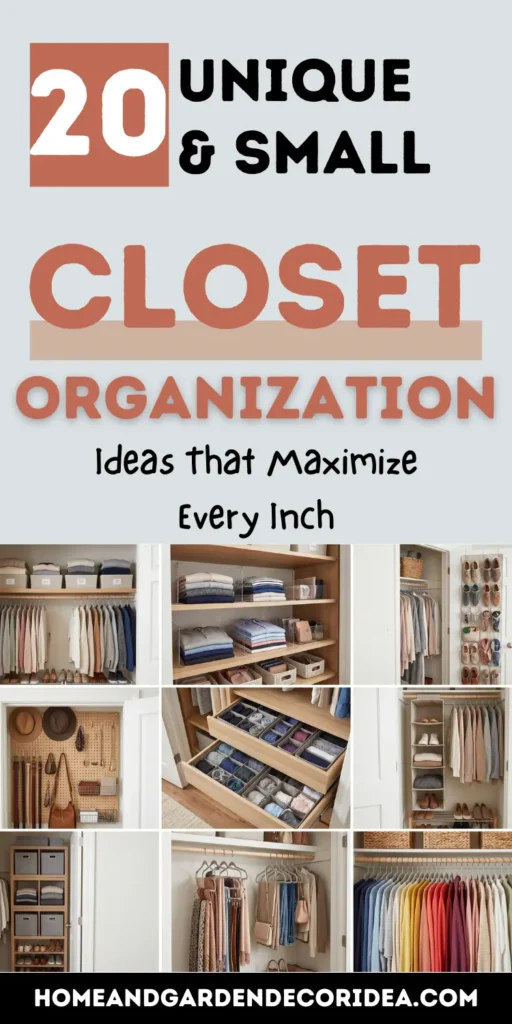
The 20 Best Small Closet Organization Ideas
1. Double Your Hanging Space With a Second Hanging Rod
This is the single most impactful small closet organization idea on this list and the one I recommend starting with — because it literally doubles your hanging capacity in the most accessible zone of the closet with one simple, inexpensive addition.
A second hanging rod — a bar that hangs from your existing closet rod via two hooks or chains — creates a lower hanging level below the original rod. Your shorter garments (tops, folded pants, jackets, blazers) hang on the lower rod, and your longer garments (dresses, pants hung by the waistband, coats) hang on the upper rod. The space that was previously empty below your hanging clothes — which can be a foot to eighteen inches of completely wasted closet height — becomes fully utilized hanging space.
The best part about this idea is that it requires no installation, no tools, and costs under $15. The double rod simply hooks onto your existing rod and hangs down. It can be removed and adjusted instantly. It works in any closet with a standard hanging rod.
Lubna’s closet transformation started here. She went from one rod holding approximately eighteen hangers to two rods holding thirty-six. The same physical space, twice the hanging capacity.
Shop it: Honey-Can-Do double hanging closet rod (Amazon), ZOBER double closet rod (Amazon), or any “closet rod doubler” on Amazon.
2. Replace Standard Hangers With Slim Velvet Hangers
This idea sounds too simple to matter — and then you do it and the visual result alone is almost shocking, and the capacity gain is immediate and significant.
Standard plastic or wire hangers are typically about half an inch thick. Slim velvet hangers are about an eighth of an inch thick. When you replace every standard hanger in your closet with slim velvet hangers, you roughly quadruple the number of hangers that fit in the same linear rod space. A rod that held twenty standard hangers holds eighty slim velvet hangers in the same space.
Additionally, velvet hangers grip fabric so garments do not slide off — which eliminates the pile of fallen clothes at the bottom of the closet that is a constant feature of wire hanger closets. And the matching, consistent look of a rod of uniform slim velvet hangers is one of the most beautiful things that can happen to a small closet. The visual organization alone makes the space feel more intentional and more spacious.
This is one of those ideas that costs about $15 to $20 for a full set and produces a result that makes you wonder why you did not do it years ago.
Shop it: Utopia Home velvet hangers 50-pack (Amazon), Amazon Basics velvet hangers (Amazon), Zober slim velvet hangers.
3. Install a Proper Closet Organizer System to Replace the Single Rod and Shelf
This is the idea that produces the most dramatic overall transformation in a small closet — and if you are willing to invest one weekend and a moderate amount of money, it will change how your closet functions more completely than any other single change.
The standard closet configuration — one hanging rod, one shelf above — is not designed to maximize any closet’s storage potential. It is the minimum viable closet: functional but completely unoptimized. A proper closet organizer system replaces this single rod and shelf with a configuration of double hanging sections, single hanging sections, built-in shelves at multiple heights, drawer sections, and shoe storage — all sized specifically to your closet’s dimensions and your wardrobe’s specific needs.
IKEA’s PAX wardrobe system is the most popular and most accessible version of this idea — it is fully configurable, remarkably affordable, and produces a result that looks far more custom than its price suggests. The Container Store’s elfa system is the premium adjustable version that offers the most flexibility for changing configurations over time.
For a small closet specifically, the most impactful configuration typically includes: a double hanging section for short garments (shirts, folded pants, jackets) taking up approximately half the closet width; a single hanging section for long garments (dresses, full-length pants) taking up the other half; and built-in shelves in any available vertical zones for folded items, shoes, and accessories.
Shop it: IKEA PAX system (IKEA), Container Store elfa system (The Container Store).
4. Use Every Inch of Door Space With Over-the-Door Organizers
The back of your closet door — whether it is a swinging door or a sliding door — is storage real estate that most small closet owners are completely ignoring, and it is the easiest additional storage zone to activate with zero modification to the closet itself.
Over-the-door organizers hook over the top of the door and hang down on the back face, providing rows of pockets, hooks, bars, or shelves. For a small closet, over-the-door storage is particularly valuable because it is additional capacity outside the closet’s main footprint — it does not compete with hanging space or shelf space. It is purely additional.
Use over-the-door pockets for shoes on the back of the closet door. Use over-the-door hooks for bags, scarves, and belts. Use an over-the-door jewelry organizer for the necklaces and bracelets and earrings that otherwise live in a tangled pile somewhere. Use an over-the-door shoe organizer for accessories and small items that do not have a natural home inside the closet.
For sliding doors specifically, over-the-door organizers that sit between the door and the door frame — designed specifically for bifold and sliding closet door applications — make the same additional storage possible even when the door geometry makes standard over-the-door hooks impractical.
Shop it: SimpleHouseware over-the-door shoe organizer (Amazon), NIUBEE hanging door organizer (Amazon), over-the-door jewelry organizer (Amazon).
5. Create a Shoe Wall With a Clear Shoe Box System
If your shoes currently live in a pile on the closet floor — and in small closets they almost always do — this idea will completely transform your closet floor situation and your shoe retrieval experience simultaneously.
Clear shoe boxes, stacked neatly and uniformly, create a wall of organized, visible shoe storage that works in every small closet regardless of floor space. The clear construction means you can identify any pair at a glance without opening the box. The uniform stacking means the boxes use vertical space efficiently rather than spreading across the floor.
For a small closet, the specific advantage of clear shoe boxes over an open shoe rack is that they are more compact per pair (no wasted space between shoe pairs), they protect the shoes from dust, and the stacked format uses vertical height rather than horizontal floor space — which is the scarce resource in a small closet.
For shoes that you do not wear frequently, vacuum-storage-style shoe bags are an additional option — they compress the space required by each pair significantly.
Shop it: IRIS USA clear stackable shoe boxes (Amazon — bestseller for good reason), Sterilite clear shoe boxes (Target), drop-front shoe boxes for easy access when stacked high (The Container Store).
6. Add a Small Dresser or Drawer Unit Inside the Closet
This idea is one that many small closet owners never think of because they imagine that a closet is only for hanging and shelf storage — but a small dresser or drawer unit placed on the floor of a closet is one of the most efficient storage solutions available for a small bedroom situation.
A narrow dresser (18 to 24 inches wide, 36 to 42 inches tall) placed inside the closet, beside the hanging section, gives you four to six drawers of folded item storage without using any bedroom floor space. Socks, underwear, t-shirts, workout gear, loungewear — everything that would otherwise need a bedroom dresser can live inside the closet in a dedicated drawer unit.
This is particularly powerful in small bedrooms where a full dresser outside the closet would take up significant floor space. Moving the dresser inside the closet frees up the bedroom floor and consolidates all clothing storage in one location.
Shop it: IKEA HEMNES 3-drawer chest (IKEA — narrow enough for many closets), IKEA KALLAX cube unit with drawer inserts (IKEA), any narrow chest of drawers at Wayfair or Amazon.
7. Use Shelf Dividers to Keep Stacks Neat and Prevent Toppling
This is the smallest-dollar, highest-return small closet organization idea on this list — shelf dividers cost about $15 for a set and they prevent the most consistent source of closet chaos: folded item stacks that topple and spread across an entire shelf, making everything harder to find and access.
Shelf dividers are small vertical panels that clip onto closet shelves and divide the shelf surface into individual zones. Each zone holds a specific category of folded item in a contained stack — sweaters in one zone, jeans in another, athletic wear in a third. When one stack topples, the dividers prevent it from spreading into neighboring zones.
In a small closet where every shelf inch matters, shelf dividers also prevent the organizational drift that happens when different categories of folded items gradually mix over weeks of use. The zones created by dividers enforce category separation passively — you do not have to actively maintain the organization because the dividers do it for you.
Shop it: Simple Houseware closet shelf dividers (Amazon), YouCopia shelf dividers (Amazon), wood shelf dividers (Amazon).
8. Hang a Mirror on the Inside of the Closet Door
A mirror inside the closet door serves the double purpose of giving you a full-length view for outfit assessment and visually expanding the closet space — because mirrors make any space feel larger by reflecting light and creating an illusion of additional depth.
In a small closet, the psychological and functional impact of a mirror is disproportionate to the cost and effort. Getting dressed becomes faster because the mirror is right there in the closet rather than requiring a trip to a bedroom or bathroom mirror. The space feels less confined because the reflective surface extends the visible depth of the closet. And the mirror provides additional reflected light in what is often a naturally dark space.
Stick-on or command-strip mounted full-length mirrors work perfectly for this application — no holes, no installation commitment, suitable for renters.
Shop it: Umbra Trigg wall mirror (full-length, slim, and beautiful), Amazon command-strip mirror (budget-friendly and damage-free).
9. Use Hanging Organizers for Bags, Purses, and Accessories
Bags and purses are one of the most space-challenging categories in a small closet — they are bulky, they do not stack efficiently, and they take up floor space that the closet cannot spare. Hanging bag organizers solve this by taking bags vertical rather than horizontal.
A multi-hook hanging organizer or a dedicated purse organizer that attaches to the closet rod holds bags hanging neatly in a vertical row, accessible individually, taking up only rod space rather than floor space. From handbags to tote bags to gym bags to clutches — each has a hook, and the floor of the closet is free.
This is the idea that Lubna credits with the single biggest practical improvement in her thirty-inch closet — she had four bags that used to live on the floor and now they hang in a six-inch wide strip of the closet rod, taking up almost no space and accessible individually.
Shop it: Simple Houseware hanging closet organizer (Amazon), purse organizer hanging for closet (Amazon search term), MISSLO hanging purse organizer (Amazon).
10. Create a Hat Shelf Using Hatboxes or Dedicated Hat Hooks
Hats are another storage category that resists the standard hanging and shelving solutions — they are too wide to stack efficiently, they lose their shape when stored unsupportively, and they tend to end up wherever they fit rather than in any organized location.
The solution for a small closet is to go vertical with hats. A row of hat hooks mounted on the inside of the closet door or on the closet wall holds hats hanging individually, maintaining their shape, taking no shelf space. Hatboxes stacked on a high shelf are the alternative — they use vertical space and protect hat shape simultaneously.
For a small closet specifically, the hook approach is usually superior because it uses door or wall space that is not competing with any other storage.
Shop it: Command hooks in multiple sizes for hat hanging (Amazon), decorative wall hooks (Amazon, Target), hatboxes for stacking (Amazon, Container Store).
11. Add a Second Shelf Above the Existing Top Shelf
In most standard closets, the top shelf is positioned at a height that leaves several feet of space between the top of the shelf and the ceiling — and that space is completely unused. A second shelf, installed above the existing top shelf, converts that dead space into usable storage.
The upper shelf is naturally best for items that are infrequently accessed — seasonal clothing in labeled bins, extra bedding, items stored for occasional use. The lower of the two top shelves (the original top shelf) remains for more regularly accessed items.
The height between the original top shelf and the ceiling in a standard 8-foot room is typically 18 to 24 inches — enough for bins, boxes, and folded seasonal items. This is the vertical storage zone that almost every small closet owner is leaving completely unused.
Shop it: Floating shelf bracket and pine board from Home Depot (DIY option), wire shelf kit from ClosetMaid (easy installation), IKEA floating shelf.
12. Label Everything — Especially Bins on High Shelves
Labels are the organization element that prevents the most consistent form of small closet drift — the drift that happens when labeled bins and containers gradually get confused, mixed, and reorganized incorrectly by anyone other than the person who set up the system.
For a small closet specifically, labels matter most on items that are not immediately visible — the bins on high shelves, the boxes in back corners, the containers holding seasonal or occasional-use items. When every container has a specific, readable label, any household member can find and return any item without disrupting the organization.
A label maker is the most satisfying option. Handwritten labels on white label tape are equally functional. The label is what matters, not the format of the label.
Shop it: Brother P-Touch label maker (Amazon), NIIMBOT wireless label maker (Amazon), simple label tape and marker (any office supply store).
13. Use Vacuum Storage Bags for Off-Season Clothing
Seasonal clothing — the heavy sweaters, the ski pants, the thick wool coats — takes up a genuinely disproportionate amount of closet space relative to the fraction of the year it is actually worn. Vacuum storage bags compress this seasonal clothing to a fraction of its normal volume, freeing up closet space for the clothing you are actually wearing right now.
The physics of vacuum storage bags make them feel slightly magical the first time you use them — a winter sweater that normally takes six inches of shelf space compresses to about an inch under vacuum. A whole winter wardrobe that would fill a large section of a small closet fits in two or three compressed bags that slide under the bed or onto a high shelf.
For a small closet, vacuum storage bags for off-season clothing are one of the highest-impact ideas on this list because they do not require any additional storage furniture or installation — they simply compress the things that are already there and give the recovered space to the things that need to be accessible.
Shop it: Space Bags vacuum storage bags (Amazon), BAGSMART vacuum storage bags (Amazon), any “compression storage bags for clothing” on Amazon.
14. Create a Jewelry Zone With Wall-Mounted or Door-Mounted Organization
Jewelry is the small closet item category most likely to create chaos in any container it is stored in — necklaces tangle, earrings get separated, rings disappear. A dedicated jewelry organization solution that keeps each piece visible, accessible, and untangled is the specific fix for this specific problem.
In a small closet, the best jewelry storage is vertical and mounted — either on the inside of the closet door (a wall-mounted jewelry organizer with individual hooks for necklaces, slots for earrings, and small trays for rings and bracelets) or on a small section of the closet side wall. This takes the jewelry completely off the shelf and off the floor and puts it on a surface that was previously unused.
The visual appeal of a well-organized jewelry display — where every necklace hangs individually and every earring pair has a slot — is an additional benefit beyond the pure functionality. Opening the closet and seeing a beautifully organized jewelry display is one of those small daily pleasures that makes the closet feel like a space you genuinely enjoy using.
Shop it: Wall-mounted jewelry organizer with mirror (Amazon), over-the-door jewelry organizer (Amazon), SONGMICS jewelry organizer (Amazon).
15. Install Hooks at Multiple Heights on Every Available Wall Surface
Hooks are the small closet organization idea with the highest versatility-to-cost ratio on this list — you can add more hooks to more surfaces for almost nothing, and every hook is an additional hanging point that keeps something off the floor and off a shelf.
In a small closet, hooks belong: on the back wall (for bags, belts, scarves), on the side walls (for robes, specific frequently-used bags, sports equipment), on the inside of the door (for tomorrow’s outfit, a robe, a bag), and at multiple heights on any of these surfaces (lower hooks for items you use most frequently, higher hooks for items used occasionally).
Command hooks are the renter-friendly, damage-free version of this idea — they hold significant weight (up to several pounds per hook), remove without damaging walls, and are available in a range of sizes for different hook applications.
Shop it: Command hooks large variety pack (Amazon — stock up, you will use more than you think), decorative wall hooks (Amazon, Target, HomeGoods).
16. Use a Shoe Rack on the Closet Floor — But the Right One
If you prefer shoes accessible and visible rather than boxed, a shoe rack on the closet floor is the right solution — but the specific design of the shoe rack matters enormously for a small closet.
The shoe racks that do not work well in small closets are the flat wire racks that store each pair horizontally and take up enormous floor space per pair. The shoe racks that work brilliantly are the tiered, angled racks that store shoes at an angle, allowing each tier to store shoes in a space-efficient footprint, or the slim shoe towers that store shoes vertically in a small floor footprint but significant height.
For a thirty-inch closet like Lubna’s, a slim shoe tower with multiple tiers can store eight to twelve pairs of shoes in a footprint of about twelve inches by twelve inches and thirty-six inches of height — significantly more space-efficient than any horizontal rack.
Shop it: SONGMICS 8-tier shoe rack (Amazon), KIMBORA stackable shoe rack (Amazon), Simple Trending shoe tower (Amazon).
17. Use the Top of the Closet for Clear Bin Storage With Labels
The very top of the closet — the space between the high shelf and the ceiling — is where labeled clear bins filled with off-season, occasional-use, or sentimental items should live. It is the right place for items you do not need regular access to, because retrieving them requires a step stool anyway.
Clear bins make this high storage zone functional rather than mysterious. Without clear bins, the tops of closets accumulate boxes and bags and unnamed containers whose contents are completely unknown until everything is pulled down and sorted. Clear labeled bins at the top of the closet maintain the organization over time — you can see from the floor what is in each bin, and returning items to the correct bin is guided by the label rather than requiring memory.
Shop it: Sterilite clear bins (Target, Amazon), IRIS USA clear storage bins (Amazon — particularly good quality for the price).
18. Fold Clothes the Space-Saving Way — File Fold Everything
This is the organization idea that requires zero products, zero money, and zero installation — but produces a significant increase in closet and drawer efficiency.
File folding — the technique made famous by the KonMari method — folds items into small rectangles that stand upright in a drawer or on a shelf, allowing every individual item to be visible and accessible simultaneously. Compare this to standard stacking, where only the top item is visible and accessible, and every item below it requires disturbing the whole stack.
File-folded t-shirts in a drawer look like a folder of filed documents — every item standing upright, every item visible, any individual item retrievable without disturbing others. On a shelf, file-folded jeans take up significantly less space than horizontally stacked jeans and are individually accessible.
For a small closet where every shelf inch matters and where accessing the right item without disrupting the whole shelf is a daily challenge, file folding is one of the most impactful changes you can make for free.
19. Add a Pull-Out Basket or Tray for Small Accessories
Small accessories — sunglasses, watches, belts, hair accessories, chargers, keys — are the items most likely to create surface chaos on any closet shelf because they do not have a natural, obvious home in a standard closet configuration.
A pull-out basket or tray, mounted on a closet shelf using a small drawer slide, gives these miscellaneous small accessories a dedicated home that is completely invisible when pushed in and completely accessible when pulled out. It is a miniature version of the pull-out shelf idea from the kitchen cabinet guides in this series — applied to the small accessory problem in a bedroom closet.
Even without a proper slide-mounted pull-out, a shallow decorative tray or a divided small tray on a closet shelf corrals small accessories in a way that keeps the shelf surface organized even when the tray’s contents are not perfectly arranged.
Shop it: Acrylic divided tray (Amazon), bamboo drawer organizer used as a tray (Amazon), or actual pull-out cabinet organizer adapted for closet shelving.
20. Do a Quarterly Closet Declutter to Keep Capacity Available
The final small closet organization idea is the most important for long-term success — and it is the one that requires no products, no installation, and no shopping.
A small closet stays organized — genuinely, sustainably organized — only when the amount of stuff stored in it is consistently at or below its capacity. The moment the closet becomes overfull, every organizational system inside it becomes irrelevant because there is simply not enough room for everything to return to its home.
The solution is a quarterly closet declutter — four times a year, pulling everything out and making honest decisions about what is still serving your wardrobe. What has not been worn in a year? What no longer fits? What is in a condition that does not merit keeping? What is a duplicate of something else you like better?
Each quarterly declutter keeps the closet’s stored volume at a manageable level and refreshes the organization that has drifted over the previous three months. It takes about an hour. It is the maintenance that makes every other idea on this list work permanently rather than temporarily.
For Lubna’s thirty-inch closet, the quarterly declutter is the idea she says is most responsible for the closet staying organized between her more intensive organizational sessions. The ideas create the system. The quarterly declutter maintains the capacity that the system depends on.
Your Small Closet Has More Potential Than You Know
Every idea on this list is achievable in a small closet. Most of them are affordable. Several of them are free. All of them — applied thoughtfully and honestly — will make your small closet hold more, look better, and function more smoothly than it ever has before.
The key insight is the one this guide started with: a small closet is not a storage problem. It is an optimization opportunity. It is a space that has been waiting for someone to look at it with the right ideas and the right intention and say: we can do so much better here. You are that person. These are the ideas. Now go make your small closet the best it has ever been.
Start with idea one — the double rod — this weekend. The $15 investment and the thirty-minute installation will double your hanging capacity by Monday. Then work through the list, one idea at a time, and watch a small closet become a closet that genuinely serves you.
Now go pin all twenty of these small closet organization ideas, share this with everyone you know who has ever opened a small closet and felt defeated by it, and go start with that first idea right now.
Pin this and save it — these 20 small closet organization ideas will make you rethink everything you assumed about what a small closet can and cannot do!

Leave a Reply