The complete, honest, and beautifully detailed guide to the no-hardware cabinet trend — because handleless kitchens are having their biggest moment yet in 2026, and if you have been wondering whether this stunning, serene, utterly uncluttered look is right for your kitchen, this guide will tell you everything you need to know to decide.
I want to tell you about the first time I walked into a truly handleless kitchen. Not a photo of one, not a rendering — an actual kitchen in a real home belonging to someone who cooked real meals in it every day.
It was at my friend Dalia’s apartment, which she had renovated the year before, and the moment I walked in I experienced one of those small but genuine design revelations where you suddenly understand why something exists that you previously only thought was aesthetic.
The kitchen was simply — clean. Not clean as in freshly wiped, though it was that too. Clean as in visually uninterrupted. No hardware breaking up the cabinet faces. No knobs or pulls catching the light or the eye.
Just continuous, smooth, unbroken cabinet fronts in a warm cream color, with perfectly flush edges and a sense of resolution that I had never felt in a kitchen before. It felt like a room that had been designed to its logical conclusion rather than a room that was almost finished.
When I asked Dalia how she opened the cabinets, she just reached forward and pressed — and the cabinet door swung open on a push-to-open mechanism that was entirely invisible from the outside.
The magic of it, that moment of a door opening with no visible mechanism, was genuinely delightful. She laughed at my expression and said “I know. People always look like that the first time.”
The no-hardware cabinet trend — which designers and researchers are calling one of the most significant kitchen design movements of 2026 — is not a new idea. Handleless cabinetry originated in European modernist kitchen design decades ago and has been quietly influencing high-end kitchen design ever since.
But 2026 represents something of a mainstream arrival for the concept: according to the National Kitchen & Bath Association, 60% of respondents prefer minimal styles, and 69% said they prefer flat and slab cabinet door styles — the door style most naturally paired with the no-hardware approach. Kitchen experts and interior designers broadly agree that handleless designs will continue to dominate the kitchen in 2026.
This is the complete guide to the no-hardware cabinet trend. What it is, how it works mechanically, what it looks like in real kitchens, what it costs relative to conventional hardware, who it is genuinely right for, and who should probably think twice before committing. Let’s get into it.
What the No-Hardware Cabinet Trend Actually Is
Let’s establish exactly what we are talking about before anything else — because the no-hardware cabinet trend encompasses several different approaches that look similar from across the room but operate differently up close.
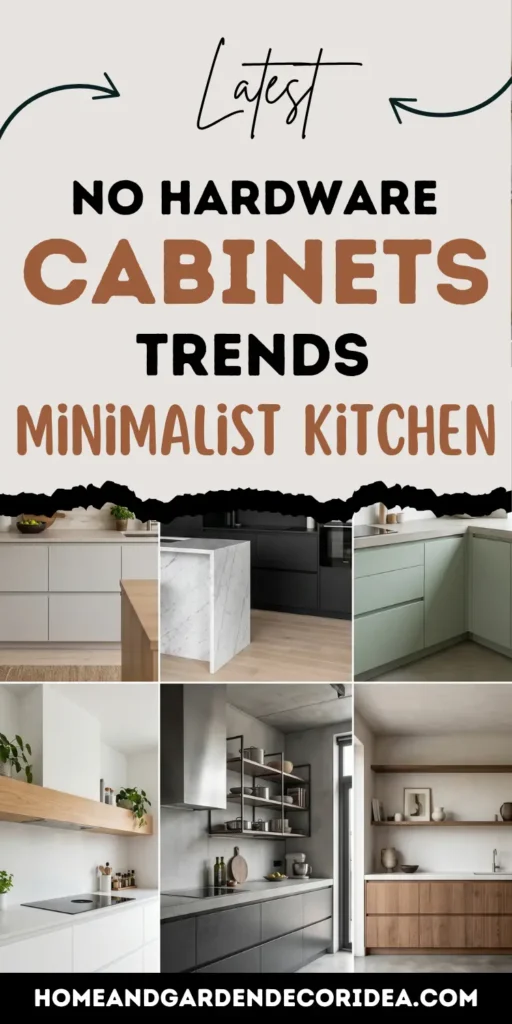
At its core, a handleless kitchen is exactly what it sounds like: cabinetry without visible handles or knobs. There is a quiet sophistication to a space where nothing interrupts the flow — no protruding hardware, no visual clutter. Just clean lines, precise detailing, and a sense of balance that feels both intentional and effortless.
But there are several different mechanisms that achieve this look:
Push-to-Open Systems
The most common mechanism in the no-hardware trend is the push-to-open system — a spring-loaded or magnetic mechanism inside the cabinet that releases when you press the door face. You press the door, it clicks and springs open toward you. Push it closed and it latches shut. Magnetic push-to-open cabinets tend to be the most common way homeowners are implementing the no-hardware trend. People favor this style’s sleek, ultra-minimalist appearance. The push-to-open system is often easier to use than traditional handles and can make your space more accessible.
The limitation of push-to-open systems: the mechanisms may wear down over time, particularly in high-use kitchens. Quality matters enormously with push-to-open hardware — budget versions lose their spring tension with heavy daily use, while premium systems from brands like Blum and Hafele maintain their performance for many years.
Gola Rail Systems
The Gola rail (also called an integrated channel or J-groove) is the premium version of the handleless concept — a horizontal groove or channel integrated into the top or bottom edge of each cabinet door that functions as the grip surface. You hook your fingers into the groove to open the door. From a distance, the groove is nearly invisible — just a thin shadow line at the edge of each door. Up close, it is a beautifully resolved detail that feels far more refined than any protruding pull.
Gola rail systems provide intuitive, ergonomic access, while modern materials ensure durability. The key is selecting the right system based on how the kitchen will be used daily. Gola rails are the system most commonly specified in luxury and high-end kitchen installations because the aesthetic result is the most refined of any handleless approach.
Edge Pulls and Recessed Pulls
A third approach — less fully committed to the no-hardware aesthetic but very much within its spirit — is the use of edge pulls or recessed pulls: very thin, nearly flush pulls that sit at the very edge of the door rather than protruding from the center of the face. Handleless designs are achieved through integrated channels, push-to-open mechanisms, or recessed pulls — these streamlined options contribute to a modern, sophisticated feel that is also highly practical, as there are no handles to bump into in a busy kitchen.
Why the No-Hardware Trend Is Having Its 2026 Moment
Understanding why this trend is happening now helps you evaluate how much staying power it has — which is important when you are making a decision that your kitchen will live with for many years.
The shift away from hardware on kitchen cabinetry is a response to the desire for more refined and modern spaces. Simplicity inspires tranquility in the kitchen, and many homeowners are aching to revamp their spaces with this in mind.
This desire for simplicity and tranquility is not an arbitrary aesthetic preference — it reflects something genuine about how people want their homes to feel in this particular cultural moment. After years of maximalism, after the visual overstimulation of screens and social media and busy work-from-home environments, people are hungry for spaces that feel resolved. Complete. Calm. A kitchen with no hardware is a kitchen that visually exhales. Nothing to catch the eye. Nothing to interrupt the surface. Just material and color and proportion, which is exactly the kind of visual rest that resonates right now.
What began as a distinctly European design approach has steadily gained traction worldwide. Over the past decade, handleless cabinetry has evolved from a niche concept into a preferred choice for high-end homes. In 2026, it is no longer simply a trend. It is a design standard for those who value clarity, refinement, and a more considered way of living.
The “no longer simply a trend” framing is significant. It suggests that the no-hardware cabinet look has crossed from trendy into something more durable — a design choice that will not read as of-the-moment-and-then-dated the way purely fashionable choices do.
The Genuine Advantages of Handleless Cabinets
Beyond the aesthetic appeal, there are practical and functional arguments for the no-hardware cabinet approach that deserve honest consideration.
Visual Continuity and a Sense of Calm
The absence of protruding hardware creates a clean, uncluttered appearance that many find appealing. The space-saving design works perfectly in open-plan kitchens. In an open-plan kitchen that flows into a living or dining area, the visual seamlessness of handleless cabinets means the kitchen does not visually announce itself as a separate zone — it integrates into the overall room more gracefully.
Timelessness of the Hardware Choice
Most handleless cabinets look timeless because the lack of hardware means your metals will never go out of style. Brass, for example, may be popular now, but chrome could be the next big thing. Homeowners who prefer not to chase trends might find handleless options to be a better choice. Further, most handleless cabinets are easier to paint, meaning you can update your color palette whenever you like.
This is a genuinely compelling argument that I think gets underappreciated in the design conversation around handleless kitchens. Hardware trends move. What is in style today — the matte black, the brushed brass, the brushed nickel — will eventually cycle out. A kitchen with no hardware is a kitchen that never has to be updated because the hardware became dated. The cabinet doors are the only design statement, and a fresh coat of paint updates the whole kitchen without any hardware decisions required.
Practical Safety Benefits
Parents particularly appreciate the added safety that comes from having no handles, especially with small children running around. This is an underappreciated practical benefit — protruding cabinet handles are a genuine hazard in kitchens with young children, who are at exactly the height of most cabinet pulls and who move through kitchens at speeds that do not allow for careful handle-avoidance. A handleless kitchen eliminates a daily source of bumps and scrapes.
Easier Cleaning
Flat-panel and slab cabinets are free of grooves, designs, or panels, meaning with nowhere for dust to settle, they stay remarkably clean. Cabinet hardware is a surprisingly significant cleaning task in any kitchen — handles and pulls collect grease and fingerprints at the most-touched points on every surface, and cleaning them properly requires removing them or working around their edges. No hardware means no hardware cleaning.
Better Flow in Small Kitchens
Handleless kitchen cabinets work great in compact spaces since they do not have protruding hardware that blocks movement. In a narrow galley kitchen or a small kitchen where the cabinet runs are close together or close to traffic paths, the absence of protruding pulls means more comfortable movement through the space.
The Real Limitations of Handleless Cabinets
Honest guidance means acknowledging what does not work as well as what does — and the no-hardware approach has specific limitations that anyone considering it should understand before committing.
The Push-to-Open Mechanism Maintenance Question
The mechanisms may wear down over time — this is the most frequently cited practical concern with push-to-open systems. A spring or magnetic mechanism that is activated dozens of times per day in a high-use kitchen will wear faster than one activated dozens of times per week. For primary kitchens in active family use, the quality of the push-to-open mechanism matters enormously, and budget systems are not a viable long-term choice.
The solution is specifying high-quality mechanisms from brands with proven track records — Blum Tip-On, Grass Tiomos, and similar premium systems are engineered for high-frequency use and maintain their performance significantly longer than entry-level alternatives.
The Installation Precision Requirement
Poor installation can undermine the look: without careful alignment, the continuous lines of handleless cabinetry can appear uneven or misaligned. This is a specific limitation of the no-hardware aesthetic that does not apply to hardware-equipped cabinets — protruding pulls draw the eye away from minor alignment variations, while perfectly flat cabinet faces make alignment variations visible and significant. A handleless kitchen looks magnificent when installed with precision and disappointing when it is not.
This means that the no-hardware cabinet trend is most successful when executed by experienced cabinet installers who are used to the exacting alignment standards it requires. It is not a DIY installation project for most people.
The “Cold and Clinical” Risk
Over time, the minimalist kitchen aesthetic may feel less distinctive as hardware-led designs cycle back into favor with new finishes and forms. And there is a related concern: the no-hardware kitchen, done without attention to warmth in materials and color, can feel sterile rather than serene. The visual calm that makes a well-executed handleless kitchen so beautiful can tip into coldness when the material palette is too cool, too uniform, or too lacking in the organic variation that natural materials and warm colors provide.
The antidote is warmth in everything else. Natural wood elements — a wood countertop, a wood-fronted island, open shelving with warm-toned objects. Warm color palette for the cabinet color. Textured backsplash. Warm metal in the faucet and any visible fixtures. The no-hardware kitchen works best when the warmth it lacks from hardware is provided generously by everything else.
Who the No-Hardware Cabinet Trend Is Right For
With a clear picture of both the advantages and the limitations, here is specific guidance on who should strongly consider handleless cabinets and who should think carefully before committing.
The no-hardware kitchen is most right for you if:
You are drawn to a contemporary, architectural aesthetic in your kitchen and find that conventional hardware feels like visual noise rather than an enhancement. You cook in a kitchen that either has good natural light or where you control the artificial lighting carefully, because handleless kitchens need good light to show their best quality — the shadows cast by Gola rails in particular are most beautiful in good light. You are planning a kitchen that you intend to keep for many years without updating the aesthetic frequently, and you value the timelessness argument around not having dated hardware to contend with. Your kitchen is part of an open-plan living space where visual integration and continuity matter. You have young children in the home and the safety benefit of no protruding handles is genuinely relevant.
Think carefully if:
Your kitchen sees extremely heavy daily use across multiple users and you are not able or willing to invest in premium push-to-open mechanisms — the mechanism quality is genuinely important for long-term performance. Your kitchen style leans traditional, farmhouse, or warm-classical — handleless cabinets feel most natural in contemporary and modern contexts, and can feel at odds with traditionally-styled kitchens. You are attracted to the idea of warm brass, unlacquered metal, or other beautiful hardware as a design element — if hardware is something you love rather than something you want to eliminate, the no-hardware approach gives up something rather than gaining it. Your installation budget does not extend to a highly experienced cabinet installer — the precision requirement is real and matters for the result.
How to Achieve the No-Hardware Look at Different Budget Levels
Handleless kitchens are generally more expensive than traditional cabinets, especially true handleless systems like Gola rails. The higher cost comes from specialized construction, precision installation, and premium hardware.
But the no-hardware look exists at multiple price points, and understanding the options helps you find the entry point that works for your specific situation.
Full Gola Rail System (Premium): The most refined and most durable handleless approach. Requires cabinet doors specifically manufactured with integrated channels, precision installation, and soft-close hinges. This is the level of specification in high-end kitchen showrooms and luxury installations. Expensive, but the result is the most architecturally resolved and the most durable over time.
Push-to-Open with Premium Mechanisms (Mid-Range): Standard flat-front or slab cabinet doors with push-to-open mechanisms from premium manufacturers (Blum Tip-On is the most commonly specified in this range). A very good result at a significantly lower cost than full Gola rail installation. Suitable for most contemporary kitchens.
Retrofit Push-to-Open on Existing Cabinets (Budget-Friendly): If you have existing flat-front cabinets and want to try the no-hardware look, push-to-open mechanisms can often be retrofitted to existing hinges. Remove existing hardware, install push-to-open mechanisms, fill old hardware holes with wood filler, repaint — and you have the no-hardware look for a fraction of a full cabinet replacement cost. This is a genuinely excellent option for rental apartments or for homeowners who want to test the concept before committing to it in a full renovation.
The No-Hardware Kitchen and the Rest of the Design
The final piece of guidance I want to offer is about how the no-hardware kitchen fits into the rest of its design — because a choice this specific and this committed creates design obligations in everything around it.
A handleless kitchen needs warmth from every other element of its design. Clean, minimalist cabinet designs with hidden hardware and push-to-open systems lead 2026 kitchen trends for a calm, clutter-free space — and warm earth tones like white oak, walnut, sand beige, and nature-inspired greens dominate luxury cabinetry colors alongside the handleless approach. These are not coincidental pairings — they are the design language that makes a handleless kitchen feel livable rather than surgical.
Warm cabinet color. Natural wood elements somewhere in the kitchen — a countertop, an island face, open shelving. A textured backsplash that adds visual interest in place of the hardware detail that has been removed. Warm lighting that emphasizes the material quality of the cabinets. Plants or herbs or any living organic element that breaks the uniformity.
The no-hardware kitchen is the minimalist canvas. Everything else in the kitchen needs to be the warm, considered, characterful content on that canvas. Get that balance right and a handleless kitchen is one of the most beautiful domestic spaces imaginable. Get it wrong and it is a cold room that looks unfinished.
Dalia’s kitchen — the one that gave me my first handleless kitchen revelation — works as beautifully as it does not just because the hardware is absent but because everything else is warm: the cream cabinet color, the white marble countertop with warm grey veining, the unlacquered brass faucet, the small herb garden on the windowsill, the worn wooden cutting board that lives on the counter. The no-hardware concept created the calm. Everything else created the life.
That is the combination to aim for. And if you get it right, you will have a kitchen that makes everyone who walks into it stop for a moment — just like I did in Dalia’s — and feel the particular pleasure of a space that has been thought through to its most resolved, most beautiful conclusion.
Now go pin this complete guide, share it with everyone you know who has been eyeing the handleless kitchen trend and trying to decide whether it is right for them, and go look at your kitchen cabinets with new eyes and a clear framework for what you actually want.
Pin this and save it — this is the no-hardware cabinet trend guide that will help you decide whether the minimalist handleless kitchen is your kitchen’s next evolution, and exactly how to do it right if the answer is yes!

Leave a Reply